
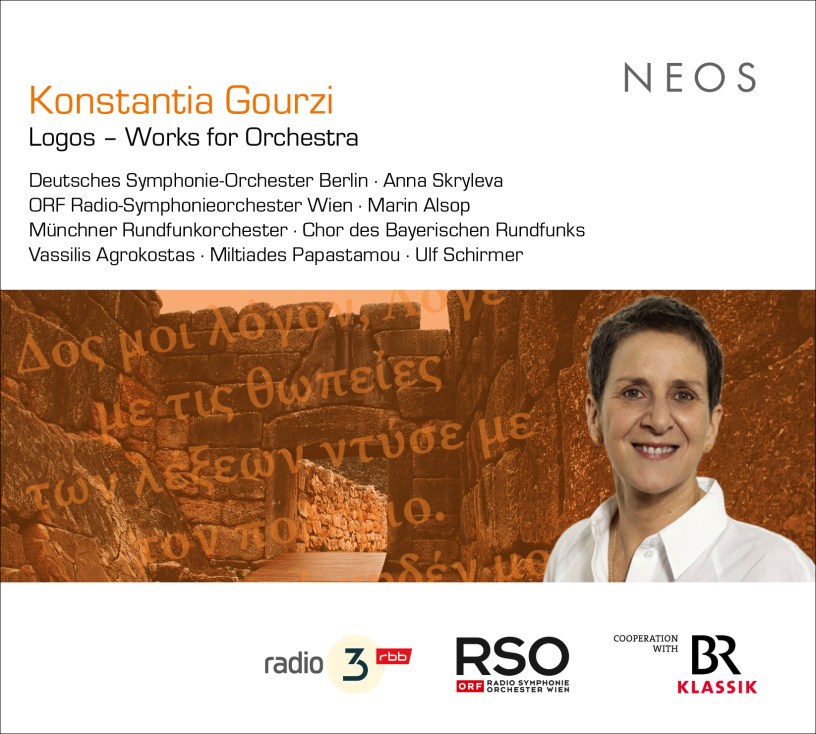
Konstantia Gourzi: Logos – Mykene, 7 Miniaturen für Orchester op. 17; Gedichte zu Prometheus für Orchester op. 28; Ostern in Konstantinopel – des Wortes wegen – 11 Momente zwischen Ost und West
Deutsches Symphonie-Orchester Berlin, Anna Skryleva (direction), ORF Radio-Symphonieorchester Wien, Marin Alsop (direction), Vassilis Agrokostas (psalmist), Miltiades Papastamou (violin), Münchner Rundfunkorchester, Chor des Bayerischen Rundfunks, Ulf Schirmer (direction)
NEOS Music 2026, Neos 12605, TT: 70’55”

(For English, please scroll down)
W twórczości współczesnej nie brakuje kompozytorów odwołujących się do tradycji, lecz rzadko spotyka się artystów, którzy czynią z niej tworzywo żywe, zdolne wchodzić w autentyczny dialog z teraźniejszością. Taka właśnie jest muzyka Konstantii Gourzi – kompozytorki i dyrygentki zakorzenionej w greckiej kulturze, a zarazem od lat związanej z niemieckim życiem muzycznym. Album Logos gromadzi jej trzy pierwsze dzieła orkiestrowe: Mykene (2002), Gedichte zu Prometheus (2005) oraz Ostern in Konstantinopel – des Wortes wegen (2010). Łączy je pojęcie logosu rozumianego nie tyle jako „słowo”, ile jako impuls do nadawania formy myślom, doświadczeniom i pamięci.
Najkrótsze z tych dzieł, Mykene, pozostaje zarazem jednym z najbardziej sugestywnych. Cykl siedmiu miniatur wyrasta z fascynacji antyczną stolicą rodu Atrydów, lecz Gourzi nie ilustruje historii. Poszczególne części są raczej krótkimi studium stanów psychicznych i śladów pamięci: niepokoju Elektry, powrotu Orestesa czy melancholii zachodzącego słońca nad ruinami. Kompozytorka operuje formą aforystyczną, kondensując materiał do granic możliwości. Kilkudziesięciosekundowe epizody mają ciężar znacznie większych konstrukcji, a ich dramaturgia opiera się na nakładaniu odmiennych planów rytmicznych i wyrazistych gestów orkiestrowych. Anna Skryleva prowadzi Deutsches Symphonie-Orchester Berlin z imponującą dyscypliną, wydobywając zarówno architektoniczną przejrzystość partytury, jak i jej ukrytą emocjonalność. To interpretacja precyzyjna, lecz pozbawiona chłodu.
Jeszcze wyraźniej indywidualny język Gourzi ujawnia się w Gedichte zu Prometheus. Kompozytorka wychodzi tu od mitu Prometeusza i greckiego pojęcia „gnosis” – poznania rozumianego jako wewnętrzne wtajemniczenie. Cztery części rozwijają się niczym kolejne etapy intelektualnej i duchowej podróży. Szczególnie przekonujące jest zestawienie ruchliwej, niemal tanecznej energii pierwszego ogniwa z lirycznym, kantylenowym charakterem drugiego. W trzecim uwagę przyciąga intensywna faktura smyczkowa, pulsująca napięciem i szorstką ekspresją, podczas gdy finał syntetyzuje wcześniejsze idee w formie przekonującego podsumowania. Marin Alsop i ORF Radio-Symphonieorchester Wien okazują się idealnymi przewodnikami po tej muzyce. Orkiestra znakomicie odnajduje się w zmiennych metrach i subtelnych zmianach kolorystycznych, a dyrygentka dba o płynność narracji, dzięki której utwór nie rozpada się na odrębne epizody, lecz zachowuje organiczną ciągłość.
Centralnym punktem albumu pozostaje jednak monumentalne Ostern in Konstantinopel – des Wortes wegen. To dzieło szczególne nie tylko ze względu na rozmiary, lecz przede wszystkim z powodu niezwykłej wizji. Gourzi tworzy muzyczny pomost między Wschodem a Zachodem, zestawiając orkiestrę symfoniczną, chór, prawosławnego psalmistę oraz skrzypce o zmodyfikowanej konstrukcji. Inspiracją stały się zarówno teksty zaczerpnięte z różnych epok greckiej kultury, od Homera po Ewangelię św. Jana, jak i doświadczenie samego Stambułu – miasta zawieszonego pomiędzy kontynentami, religiami i historiami.
Największe wrażenie robi sposób, w jaki kompozytorka unika folklorystycznej dosłowności. Elementy bizantyjskie nie funkcjonują tutaj jako egzotyczny ornament, lecz stanowią integralną część języka muzycznego. Solowe interludia psalmisty Vassilisa Agrokostasa i skrzypka Miltiadesa Papastamou otwierają przestrzeń kontemplacji, podczas gdy partie chóralne i orkiestrowe budują szerokie perspektywy brzmieniowe. Szczególnie pamiętne pozostają fragmenty „Fanári” oraz finałowa „Abschiedsnacht”, gdzie czas zdaje się ulec zawieszeniu, a muzyka osiąga rzadko spotykaną równowagę pomiędzy medytacją a dramatem. Ulf Schirmer, Münchner Rundfunkorchester i Chor des Bayerischen Rundfunks realizują tę wizję z pełnym przekonaniem. Chór zachwyca kulturą dźwięku i precyzją intonacyjną, zaś orkiestra potrafi równie sugestywnie kreować monumentalne kulminacje, jak i niemal ascetyczne przestrzenie ciszy.
Logos jest albumem niezwykle spójnym mimo dzielących poszczególne utwory lat. Już w tych pierwszych partyturach słychać cechy, które później stały się znakiem rozpoznawczym Gourzi: myślenie kategoriami krótkich, skoncentrowanych form, wyjątkową wyobraźnię kolorystyczną oraz umiejętność prowadzenia dialogu między tradycjami bez popadania w stylistyczny eklektyzm. To muzyka, która nie narzuca znaczeń, lecz zaprasza do wsłuchania się w ich źródło.
Wydawnictwo NEOS dokumentuje nie tylko początek ważnej twórczej drogi. Pokazuje również, że we współczesnej muzyce orkiestrowej wciąż możliwe jest połączenie intelektualnej ambicji z bezpośrednią siłą oddziaływania. Logos należy do tych płyt, które zostawiają po sobie nie tyle wspomnienie pojedynczych tematów czy efektów brzmieniowych, ile poczucie uczestnictwa w przemyślanej, głęboko osobistej opowieści.
Robert Majewski © 2026
Płyty można posłuchać w serwisie Apple Music.
(English version)
There is no shortage of contemporary composers who draw upon tradition. Far rarer, however, are those who transform it into a living medium, capable of engaging in a genuine dialogue with the present. Such is the music of Konstantia Gourzi, a composer and conductor deeply rooted in Greek culture while remaining closely connected to German musical life for many years. Logos brings together her first three orchestral works: Mykene (2002), Gedichte zu Prometheus (2005), and Ostern in Konstantinopel – des Wortes wegen (2010). What unites them is the notion of logos, understood not merely as “word,” but as the impulse that gives form to thought, experience, and memory.
The shortest of these works, Mykene, is also among the most evocative. This cycle of seven miniatures grows out of a fascination with the ancient stronghold of the House of Atreus, yet Gourzi does not seek to illustrate history. Rather, the individual movements function as concise studies of psychological states and traces of memory: Electra’s unrest, Orestes’ return, or the melancholy of a setting sun over ruined stones. The composer employs an aphoristic form, compressing her material to its utmost limits. Episodes lasting barely a minute carry the weight of far larger structures, their dramatic force arising from the superimposition of contrasting rhythmic layers and vividly etched orchestral gestures. Anna Skryleva leads the Deutsches Symphonie-Orchester Berlin with remarkable discipline, bringing out both the architectural clarity of the score and its hidden emotional undercurrents. It is a reading of precision without austerity.
Gourzi’s individual voice emerges even more clearly in Gedichte zu Prometheus. Here she takes as her point of departure both the myth of Prometheus and the Greek concept of gnosis – knowledge understood as an inner awakening. The four movements unfold like successive stages of an intellectual and spiritual journey. Particularly compelling is the contrast between the restless, almost dance-like energy of the opening section and the lyrical, cantabile character of the second. The third draws attention through its dense string writing, pulsing with tension and rugged expressivity, while the finale gathers the preceding ideas into a convincing synthesis. Marin Alsop and the ORF Radio-Symphonieorchester Wien prove ideal guides to this music. The orchestra navigates shifting metres and subtle colouristic transformations with ease, while Alsop ensures a fluid narrative line that allows the work to retain its organic continuity rather than fragmenting into separate episodes.
The centrepiece of the album, however, is the monumental Ostern in Konstantinopel – des Wortes wegen. This is a remarkable work not only because of its scale, but above all because of the singularity of its vision. Gourzi builds a musical bridge between East and West, bringing together symphony orchestra, choir, Orthodox psalmist, and a specially modified violin. Its inspiration lies both in texts drawn from different epochs of Greek culture, from Homer to the Gospel of Saint John, and in the lived experience of Istanbul itself, a city suspended between continents, religions, and histories.
Most impressive is the way the composer avoids all folkloristic literalism. Byzantine elements do not function as exotic ornamentation; they form an integral part of the musical language itself. The solo interludes of psalmist Vassilis Agrokostas and violinist Miltiades Papastamou open a space for contemplation, while the choral and orchestral passages create expansive sonic perspectives. Particularly memorable are the sections entitled “Fanári” and the concluding “Abschiedsnacht,” where time itself seems suspended and the music achieves a rare equilibrium between meditation and drama. Ulf Schirmer, the Münchner Rundfunkorchester, and the Chor des Bayerischen Rundfunks realise this vision with complete conviction. The choir impresses with its tonal refinement and impeccable intonation, while the orchestra proves equally persuasive in shaping monumental climaxes and near-ascetic realms of silence.
Logos remains an extraordinarily cohesive album despite the years separating its constituent works. Even in these early scores one can already hear the qualities that would later become hallmarks of Gourzi’s style: a preference for concentrated forms, an exceptional gift for orchestral colour, and an ability to foster dialogue between traditions without ever slipping into stylistic eclecticism. This is music that does not impose meanings upon the listener, but invites reflection on their origins.
The NEOS release documents more than the beginning of an important artistic journey. It also demonstrates that contemporary orchestral music can still unite intellectual ambition with immediate communicative power. Logos belongs to that rare category of recordings that leave behind not so much the memory of individual themes or sonic effects as the feeling of having taken part in a thoughtful and deeply personal narrative.
Robert Majewski © 2026
Płyty można posłuchać w serwisie Apple Music.

