
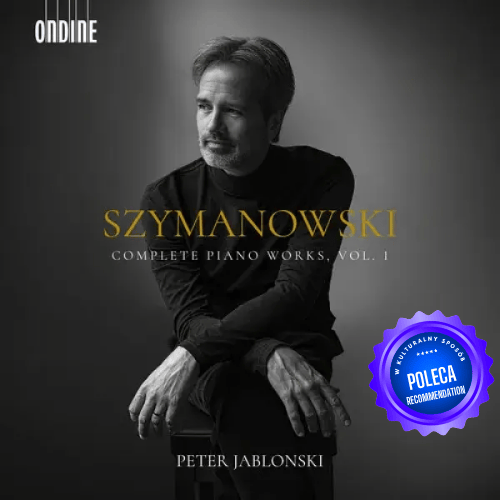
Karol Szymanowski: Complete Piano Works, vol. 1
Peter Jablonski (fortepian)
Ondine 2026, ODE1484-2, TT: 78’30”
Muzyka fortepianowa Karola Szymanowskiego wymaga od wykonawcy nie tylko znacznych możliwości technicznych, lecz także umiejętności porządkowania rozbudowanej, często wielowarstwowej faktury. Peter Jablonski w pierwszym tomie planowanego kompletu dzieł fortepianowych bardzo dobrze zachowuje równowagę między brzmieniową stroną tych utworów a ich konstrukcją. Gra precyzyjnie i klarownie, wyraźnie różnicuje plany, a jednocześnie pozostawia sobie dużą swobodę w kształtowaniu tempa, dynamiki i frazy. Dzięki temu nawet najbardziej złożone fragmenty Metop i Masek zachowują czytelność, nie tracąc nic ze swojej kolorystycznej intensywności.
Album tworzy przy tym znakomitą opowieść o stylistycznej ewolucji kompozytora. Wariacje b-moll op. 3 oraz Wariacje na polski temat ludowy op. 10 pokazują młodego Szymanowskiego pozostającego jeszcze w orbicie romantyzmu, Chopina i Skriabina, ale coraz śmielej komplikującego harmonię, rytm i fakturę. Jak zauważa w świetnym omówieniu Anastasia Belina, zarazem producentka nagrania, w obu cyklach wyraźne są ślady nauki u Zygmunta Noskowskiego: praca kontrapunktyczna, krótkie komórki tematyczne, formy taneczne czy wariacje konstruowane na podstawie struktur harmonicznych. Jablonski zachowuje romantyczny gest tej muzyki, ale nie pozwala, by rozbudowane formy rozpadły się na ciąg pianistycznych efektów.
Prawdziwa metamorfoza dokonuje się w Metopach op. 29. Inspirowane kulturą śródziemnomorską portrety Syren, Kalipso i Nauzykai są już muzyką barwy, ruchu i niezwykłej harmonicznej płynności. W Wyspie Syren falujące arpeggia, tryle, trytony i struktury całotonowe zacierają tradycyjne centrum tonalne. Kalipso jest ciemniejsza i bardziej zmysłowa, natomiast taneczna Nauzykaa poprzez długie accelerando zmierza ku niemal ekstatycznej kulminacji. Jablonski imponuje przejrzystością: nawet w najbardziej nasyconych fragmentach słychać poszczególne warstwy faktury.
Jeszcze bardziej teatralne są Maski op. 34. Tajemnicza Szeherezada rozwija się jak kapryśna muzyczna narracja; groteskowy Tantris błazen, inspirowany przewrotną wersją historii Tristana i Izoldy, prowadzi od ekscentryczności i gwałtowności do przejmującego wygaszenia. Wirtuozowska Serenada Don Juana staje się natomiast psychologicznym portretem uwodziciela, z gwałtownymi zmianami tempa, metrum, faktury i temperatury ekspresji. Pianista potrafi przy tym przechodzić od monumentalnego brzmienia do niemal kameralnej subtelności bez utraty ciągłości narracji.
Nagranie powstało na fortepianie Fazioli F278 w Fazioli Concert Hall w Sacile, a jego brzmienie znakomicie eksponuje zarówno głęboki bas, jak i wieloplanowość faktury. Projekt ma przy tym ważny wymiar promocyjny: jego partnerami są Instytut Adama Mickiewicza oraz prowadzony przez IAM portal Culture.pl, którego misją jest przybliżanie polskiej kultury międzynarodowej publiczności; wydanie zostało ponadto współfinansowane przez Ministra Kultury i Dziedzictwa Narodowego. To mecenat szczególnie trafny wobec przedsięwzięcia, które ma szansę stać się ważnym punktem odniesienia w fonografii Szymanowskiego.
Jako pierwszy rozdział większego cyklu album Petera Jablonskiego stawia poprzeczkę wysoko. Wirtuozeria nie jest tu celem, lecz narzędziem służącym barwie, formie i narracji. Dzięki temu Szymanowski brzmi nie jak kompozytor zamknięty w swojej epoce, lecz jak twórca zdumiewająco nowoczesny.
Robert Majewski © 2026
Płyty można posłuchać w serwisie Apple Music.
Karol Szymanowski’s piano music demands not only considerable technical resources from the performer, but also the ability to bring clarity and order to its elaborate, often densely layered textures. In the first volume of his projected complete survey of the composer’s piano works, Peter Jablonski strikes an admirable balance between sonority and structure. His playing is precise and lucid, with clearly differentiated planes of sound, yet he retains considerable freedom in shaping tempo, dynamics and phrasing. As a result, even the most complex passages in Métopes and Masques remain transparent without sacrificing any of their richness of colour.
At the same time, the album offers a compelling account of the composer’s stylistic development. The Variations in B-flat minor, Op. 3 and Variations on a Polish Folk Theme, Op. 10 reveal the young Szymanowski still firmly within the orbit of Romanticism, Chopin and Scriabin, while increasingly pushing the boundaries of harmony, rhythm and texture. As Anastasia Belina, who also produced the recording, observes in her excellent booklet essay, both sets bear clear traces of Zygmunt Noskowski’s teaching: contrapuntal writing, concise thematic cells, dance forms, and variations constructed around harmonic frameworks. Jablonski preserves the Romantic sweep of this music, while ensuring that its large-scale forms never fragment into a mere succession of pianistic effects.
A genuine transformation takes place in Métopes, Op. 29. Inspired by Mediterranean culture, these evocations of the Sirens, Calypso and Nausicaa inhabit a world of colour, movement and extraordinary harmonic fluidity. In L’île des Sirènes, undulating arpeggios, trills, tritones and whole-tone formations blur any conventional sense of tonal centre. Calypso is darker and more sensuous, while the dance-like Nausicaa builds through an extended accelerando towards an almost ecstatic climax. Jablonski is particularly impressive in the clarity he brings to these works: even in the most densely scored passages, the individual layers of the texture remain distinctly audible.
Masques, Op. 34 is even more theatrical in character. The enigmatic Shéhérazade unfolds as a mercurial musical narrative, while the grotesque Tantris le Bouffon, inspired by an ironic reworking of the Tristan and Isolde story, moves from eccentricity and violence towards a haunting dissolution. The virtuosic Sérénade de Don Juan, in turn, becomes a psychological portrait of the seducer, articulated through abrupt shifts of tempo, metre, texture and expressive character. Jablonski moves effortlessly between monumental sonorities and almost chamber-like intimacy without compromising the continuity of the musical argument.
The recording was made on a Fazioli F278 in the Fazioli Concert Hall in Sacile, an instrument whose sound brings out both the depth of the bass register and the music’s multi-layered textures particularly effectively. The project also has an important role in promoting Polish culture internationally: its partners include the Adam Mickiewicz Institute and Culture.pl, the Institute’s platform dedicated to bringing Polish culture to audiences around the world. The release was also co-financed by Poland’s Minister of Culture and National Heritage. Such support is particularly well placed for a project that has every chance of becoming an important point of reference in the Szymanowski discography.
As the opening chapter of a larger cycle, Peter Jablonski’s album sets a high standard for what is to follow. Virtuosity is never an end in itself, but a means of shaping colour, form and musical narrative. The result is a Szymanowski who sounds not like a composer confined to his period, but like a strikingly modern musical voice.
Robert Majewski © 2026
The album is available to listen to on Apple Music.

